How Do I Get the Best Settlement Offer?
Posted: October 5th, 2026
Written by: Mark Siemer
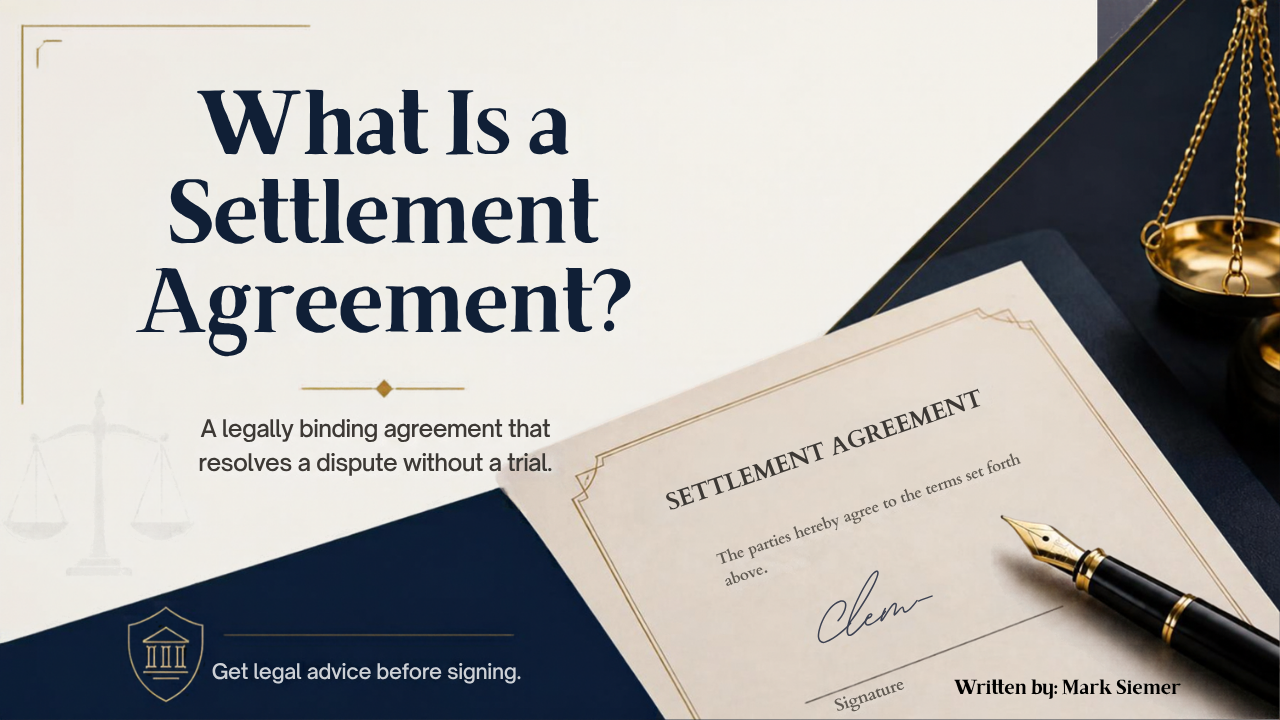
What is a Settlement Agreement?
A settlement agreement is exactly what is sounds like, an agreement to settle the dispute. It is the most common end to a lawsuit and most people who file lawsuits expect the lawsuit to settle. In construction litigation, however, settlement is better understood as a strategic tool for controlling risk. It can protect a client from the uncertainty, cost, delay, and business disruption that accompany disputes involving payment, defective work, delay claims, liens, bonds, indemnity, or insurance coverage. However, that true, but simple, expectation overlooks a few parts of the process. The most overlooked part of the phrase “settlement agreement” is the word agreement.
Why would I want to settle?
There are no guarantees in the law.
Every lawsuit is a series of gambles that have risks you can control and risks you cannot control. For example, a judge might make a mistake in their ruling in the first few months in litigation that you cannot appeal until there is a final resolution or a juror might lose focus during your star witness but cling to every word the other side has to say. Construction cases can multiply those uncertainties because they frequently involve multiple contracts, change orders, schedules, subcontractors, suppliers, insurers, and competing expert analyses.
A settlement does not mean that a party lacks confidence in its case. It means that the party has evaluated the risks and costs of continuing to litigate against the value of a known, negotiated resolution. It also increases the likelihood that party will actually get paid. Just because a judge gives you an award for money damages, does not mean that you will be able to collect that award. Or, it might mean that you spend several more months and more money searching for assets to seize to satisfy that award. In that sense, settlement is a risk-control device.
Settlement buys certainty.
Settlement also permits solutions that a court generally cannot order after a trial. A judgment may award damages, declare rights, or impose certain equitable remedies, but it usually will not provide the complete business resolution that construction participants need. A negotiated agreement can include mutual releases, confidentiality provisions, non-disclosure obligations, non-disparagement language, tailored payment schedules, lien releases, corrective-work arrangements, return of materials or equipment, insurance-cooperation provisions, and procedures for resolving future warranty issues.
Confidentiality can be particularly important in the construction industry. Public litigation may expose allegations concerning workmanship, payment practices, project management, safety, or delays. Even where allegations are unproven, the dispute itself can affect reputations, relationships with owners and contractors, and future bidding opportunities. A carefully drafted settlement agreement can limit disclosure of the settlement amount and negotiated terms, subject to legal, insurance, and regulatory exceptions that may apply.
How do I get a Settlement Agreement?
A settlement agreement is a VOLUNTARY agreement to end the dispute on the terms of the agreement. The agreement is a contract. If the agreement is violated you can sue for a breach of the contract just like any other contract. Either party can make an offer or demand to settle and they can condition it on a wide range of terms. Then it is up to the other side to accept, reject, or counteroffer.
Just like any other contract, it has to be voluntarily entered into. Meaning, if the Plaintiff demands $100,000 to settle all claims, the Defendant has to: (1) have $100,000; (2) be willing to give the Plaintiff $100,000; and (3) agree to the terms set out in the demand. Once the terms are agreed to the settlement will be reduced to writing and signed by the parties. It does not matter how reasonable your settlement offer is if the other side won’t agree to it.
That means that if you want a fast settlement, you probably have to give (or give up) more. If you want the best settlement you probably have to fight more.
How Do I Get the Best Settlement Offer
The best way to get a settlement is to be in the best position to go to trial. You are calculating your odds of success and the other side is calculating your odds of failure. That means understanding what evidence is weak and what evidence is strong. It also means understanding how you will actually prove damages. Often times the real fight is over the amount of financial injury instead of the existence of financial injury.
That does not make settlement exclusively a defense tool. Plaintiffs also use it to obtain prompt recovery and avoid collection or trial risks. But because an effective settlement requires agreement, a defendant can use its consent as leverage to seek protections that a plaintiff may not obtain through a judgment alone.
The best settlement strategy begins early. Counsel should identify the client’s legal exposure, insurance position, project documents, evidence, business objectives, and non-monetary concerns. From there, settlement can become more than an exit from litigation. It can be a deliberate mechanism for preserving capital, protecting reputation, controlling risk, and bringing a construction dispute to a final and workable close.
That being said, an early settlement is never a guarantee and if your litigation strategy requires an early settlement to make sense, you do not have a litigation strategy you have a gambling strategy.
Mark Siemer, is a Construction Attorney with Volk Law Offices, P.A., has 8 years’ experience and can be reached at help@volklawoffices.com or by visiting VolkLaw online at VolkLawOffices.com. Read more about Attorney Mark Siemer. Call for a consultation: 321-726-8338.
The matters discussed here are general in nature and are not to be relied upon as legal advice. Every specific legal matter requires specific legal attention.
The law is constantly changing and matters discussed today may not be the same tomorrow. Legal matters are also subject to different interpretations by attorneys, judges, jurors and scholars. No attorney-client relationship is intended or created as a result of matters discussed here. You should consult counsel of your choice if you have any dealings in these areas of the law. Volk Law Offices, P.A. and its attorneys make no representations or warranties with respect to the accuracy or completeness of the matters addressed.